



The war in Iran and the shipping bottlenecks through the Strait of Hormuz have pushed energy prices higher, compounding a global market environment already strained by the policy volatility of last year’s Liberation Day tariff shock. These developments introduce an additional layer of geopolitical uncertainty on top of existing trade-related headwinds. While the geopolitical and economic realities are both fluid, the consequences of this conflict could be long-lasting, altering input costs and supply chain timelines.
The following questions and answers provide a framework for evaluating what these changing dynamics mean for long-term investors and their portfolios.
Inflation is starting to creep up again. How much of an impact could this have on the economy in the near term?
The impact could be significant. Energy is a primary input cost across global supply chains. Elevated crude and natural gas prices are driving cost increases, most notably across transport, agriculture, and manufacturing industries.
The disruption is more serious within the materials complex. The closure of the Strait has constrained approximately 50% of global ethylene and polyethylene capacity. According to Dow CEO Jim Fitterling, even an immediate reopening of the Strait would require approximately 275 days to clear the logjam. Other industry analysts corroborate that timeline, with Packaging Dive reporting that the renormalization of polyolefin supply is not expected until 2027 at the earliest. Regional natural gas disruptions have spiked fertilizer costs, creating an inflationary pass-through into agricultural production and food prices.
There is also a category of second-order effects that may be underappreciated. For example, transportation services such as air travel and hospitality are all energy-intensive to operate. Higher costs like this feed into services inflation globally, which can be stickier and may be harder for central banks to dismiss as transitory. The other dynamic that concerns policymakers is the hit to real income, which could lead to a notable pullback in consumer spending and, therefore, a slowdown in the economy.
Overall, equity markets have held up since the war began despite the high economic uncertainty. Why hasn’t the equity market reacted more negatively?
Despite a 10-week closure of the Strait, the shock to global growth has been surprisingly contained. There are three reasons why the damage has been muted so far:
- Higher Inventory Buffers and Policy Credibility: Global oil markets entered this period with high pre-conflict inventories, which provided an immediate cushion. Governments stockpiled cheap crude in 2025, adding 477 million barrels to their reserves. In addition, pricing suggests that an extreme spike would trigger a policy response, such as additional release from reserves to help mute the blow.
- Demand Adaptability: Physical deficits in tight segments, such as jet fuel, have been managed through efficient responses rather than economic contraction. For example, global airlines have optimized capacity by cutting underperforming, low-margin routes via flight cancellations. Also, China’s shift towards renewable energy has insulated its broader grid from fossil fuel shocks.
- Macro Drivers: The third is the AI investment boom and the much better-than-expected Q1 U.S. corporate earnings season. Global demand has been insulated by a robust capital expenditure boom flowing into AI infrastructure and broadly supportive financial conditions. According to FactSet’s Earnings Insight, the S&P 500 reported blended year-over-year earnings growth of 28.4% for Q1 2026, with 84% of companies beating estimates, the highest earnings growth rate in several years.
Should I be thinking about my international exposure differently now?
The short answer is yes. Regional diversification that looked balanced before the conflict now carries different risks due to a divergence in energy dependence and index compositions.
United States: Structurally insulated. The energy intensity of U.S. GDP has declined steadily for decades, and the U.S. has been a net total energy exporter since 2019. While not immune, the U.S. economy is far less vulnerable to oil shocks than it was a generation ago.
Europe: Highly vulnerable. As a heavy energy importer, a sustained shock squeezes corporate margins and depresses consumer spending, forcing central banks into a stagflationary dilemma. This erodes earnings’ visibility and complicates the outlook for European equities.
Asia (Tech Heavy): The tech-heavy region is index-insulated but not economically insulated. The Taiwanese and South Korean equity markets have been shielded from the war’s repercussions due to their heavy concentration in tech and semiconductors. While higher energy costs burden their domestic consumers, they are not a primary driver of equity performance. However, this protection depends on the AI boom; if AI spending cools down, these tech-heavy markets will feel the impact of the energy shock.
Asia (Non-Tech): Economies without the technology buffer face a harsher environment as rising oil prices worsen their terms of trade. Also, the strong dollar and elevated U.S. rates place heavy pressure on EM currencies, risking a restrictive policy stance amid currency depreciation.
Should I be making significant changes to my portfolio right now?
Given that overall corporate fundamentals remain healthy and consumer financial health remains in good standing, we believe the impulse to react to short-term geopolitical events and make large portfolio changes is likely not beneficial for most investors. Geopolitical shocks, even serious ones with real economic consequences, tend to produce short-term volatility and negative returns, but looking farther out, months after the shock, markets tend to produce healthy returns. Historical S&P 500 return data illustrate this point. On average, the index has returned +5.8% at six months, and +12.1% at twelve months following major geopolitical events since 1940 (as of April 30, 2024), despite typical short-term declines in the first weeks.
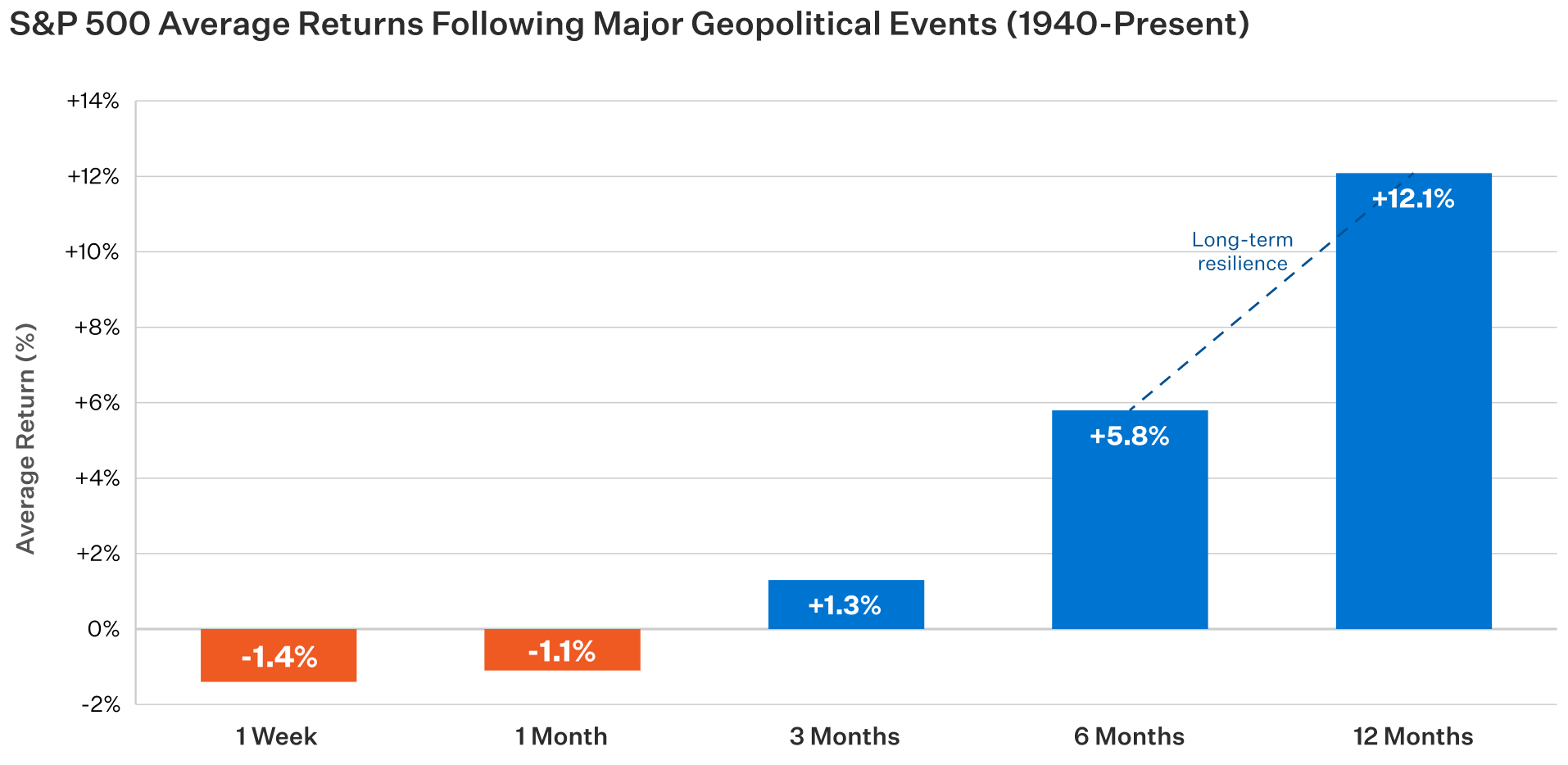
Source: Bloomberg historical data, 1940-present, via Nasdaq. As of April 30, 2024. Past performance is not indicative of future results.
Given that markets have historically rebounded, investors who move to the sidelines at the onset of major crises usually miss out on the market recovery. In our view, periods of heightened uncertainty are typically not a good reason to deviate from a long-term allocation, particularly when corporate and consumer balance sheets remain in good shape. For investors whose portfolios appropriately reflect their risk tolerance, time horizon, and financial objectives, we believe the current conflict is unlikely to warrant significant changes to their asset allocations.
I thought that gold was a safe-haven asset that performed well during geopolitical crises. Why is it down?
This is one of the most common questions we’re asked. To explain this paradox, we must look at the two main drivers of gold pricing.
Higher Real Yields: Unlike a bond, which pays interest, or a stock, which may pay dividends, gold is a non-yielding asset. Therefore, one of its biggest competitors is the risk-free return on U.S. Treasury securities. When oil prices surged, it triggered an immediate inflation scare and led the market to price out the rate cuts it had been expecting in 2026. As a result, the 10-year Treasury yields rose to their highest levels in a year. When yields rise, the opportunity cost of holding a non-yielding asset increases, prompting investors to shift capital away from an asset like gold toward other assets.
U.S. Dollar: Capital fled importing regions like Europe and rushed into the U.S. Dollar for safety and liquidity. Higher interest rates in the U.S. compared to the rest of the world also made the dollar attractive. Since gold is denominated in U.S. dollars, a stronger dollar automatically makes gold more expensive for international buyers, suppressing demand and driving its price down.
What are some of the key risks you’re watching?
We are closely watching how the Fed responds to the growing tension between economic data and political pressure. Stagflationary concerns are back on the table, with inflation reaccelerating to 3.8% in April and higher energy prices posing risks to consumer spending and economic growth. However, the labor market remains resilient, with unemployment low and payroll growth continuing to hold up, conditions that traditionally would argue against rate cuts.
At the same time, President Trump has become increasingly vocal in calling for lower interest rates to support economic growth and offset the impact of higher energy prices and tariffs. As a result, the June meeting is shaping up to be a test of Fed independence as much as a discussion about the future path of interest rates. The Fed’s decision and its messaging will be signs of whether policymakers remain focused on inflation and employment data or are beginning to respond to political pressure.
For equities, although the Iranian conflict has created one of the largest oil supply disruptions in modern history and has the potential to slow global economic growth, equity investors have largely looked past the risk. Instead, investor focus remains on the AI infrastructure buildout and the highly anticipated pipeline of SpaceX, OpenAI, and Anthropic. In addition, a strong earnings season, coupled with unprecedented AI capital spending, has fueled a powerful market rally, led by semiconductors, with the semiconductor index up 88% year-to-date.
The underlying driver remains demand. Hyperscalers are sitting on roughly $900 billion in cloud AI-related backlog, highlighting the enormous appetite for AI computing capacity and driving another wave of infrastructure investment. That spending flows directly to the beneficiaries of the AI ecosystem, including chipmakers, data center operators, construction firms, electrical equipment providers, and energy companies. At the same time, supply remains constrained across several parts of the value chain, creating favorable industry dynamics and allowing a broader group of companies to participate in the rally.
The key risk is not the long-term outlook for AI infrastructure or semiconductors, but rather the extent to which the theme has become entrenched in investor portfolios and market expectations. Current valuations across AI infrastructure, such as semiconductors, AI-adjacent industrials, and AI hardware, are pricing in a sustained hyperscaler capex ramp; however, if cloud providers begin moderating capex growth, semiconductor multiples could compress. Likewise, if future AI model improvements fail to deliver meaningful productivity gains for consumers and enterprises, the urgency to invest could diminish, slowing the pace of AI-related spending.
While we remain constructive on the AI buildout, the market is increasingly pricing in a near-perfect outcome. The long-term opportunity remains significant, but investors should recognize that expectations are now extremely high, making execution and sustained demand growth critical to supporting current valuations.