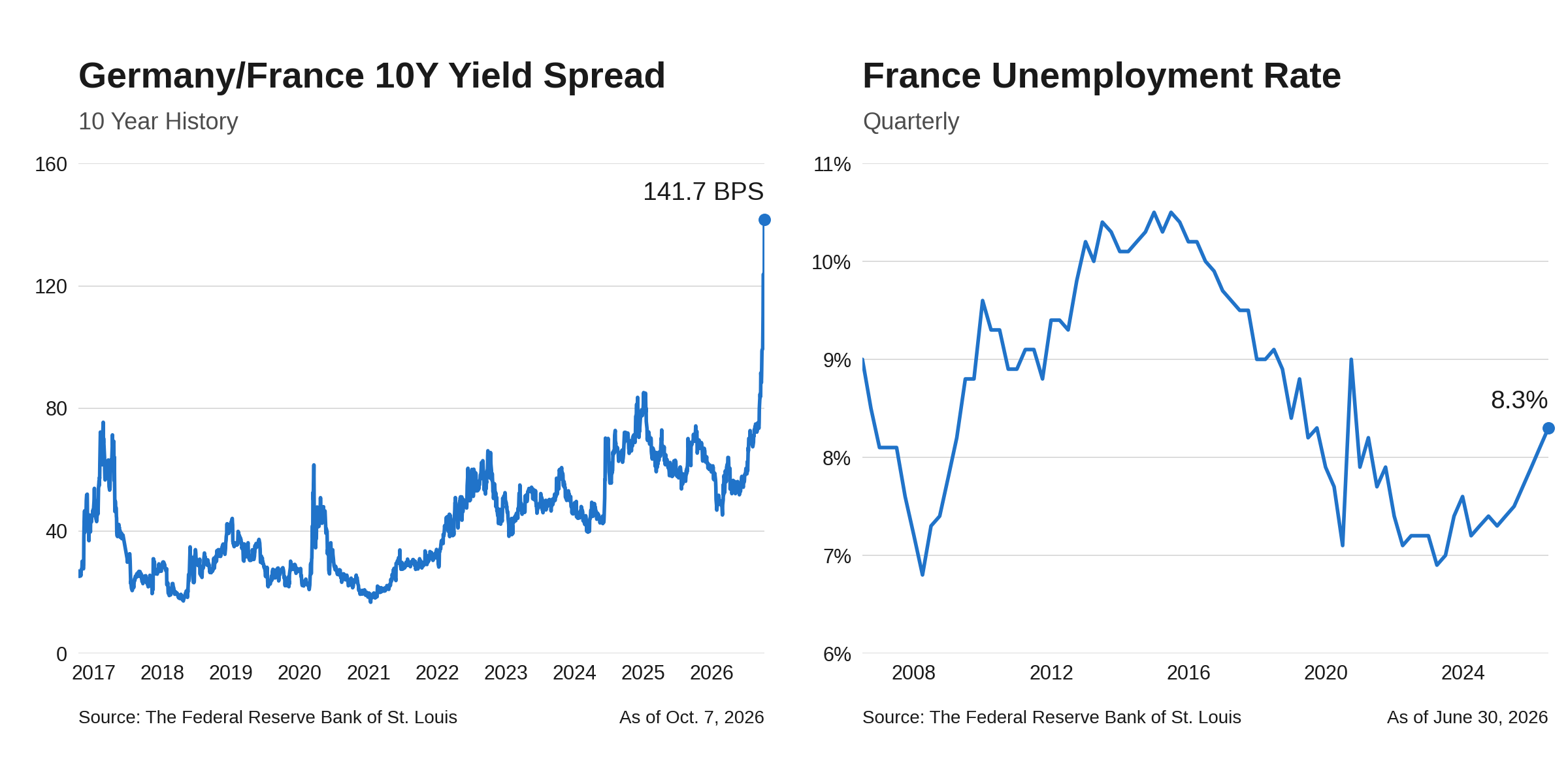
If you’ve been following the headlines about the “French debt crisis,” you know that borrowing costs are surging. In our estimation, investors are charging France more to borrow because they doubt its politicians can agree on how to cut the deficit. We view this as a confidence problem, not a default, since France has deep markets, a rich economy, and the European Central Bank (ECB) behind it. But the cost of lost confidence is rising and starting to ripple across Europe.
What’s Happening
Borrowing costs are at 14-year highs. France pays close to 5% on 10-year debt, about 1.3 to 1.5 percentage points more than Germany, the widest gap since the 2011–12 eurozone debt crisis.
The budget has slipped. The deficit is about 5.4% of GDP in 2026, above the 5% target and the EU limit of 3%. Debt is about 117% to 119% of GDP and rising.
The economy is weak. Growth is just 0.4% to 0.5% in 2026, hit by energy prices after the Iran war, a heat wave, and drought. Unemployment is 8.3%.
The political climate and calendar are challenging. A minority government must pass a tough 2027 budget months before the spring 2027 presidential election.
Why It’s Happening, and Why It’s Hard to Fix
France has not balanced its budget in over 50 years. It spends about 57% of GDP, the most in the EU, much of it on pensions and health care, and taxes are already among the world’s highest. Politics changed after the 2024 snap legislative election: The National Assembly split into three blocs, and two prime ministers were forced out over budget cuts.
Many agree that France must curb its spending, but they disagree on what to cut. Raising the retirement age to 64 in 2023 sparked months of strikes, and it was suspended in 2025. Scrapping two public holidays helped bring down Prime Minister François Bayrou. Holding pensions below inflation helped topple Prime Minister Michel Barnier and is back in the 2027 budget’s €54 billion of savings. With an election coming, parties are reluctant to own the pain.
The Le Pen Factor
National Rally presidential candidate Marine Le Pen, who leads the polls, moved to reassure markets on October 6: €140 billion in savings by 2032, a constitutional deficit rule, a balanced budget within 18 months (excluding interest costs), and a deficit below 3% by 2030. The gap with Germany narrowed about 0.2 points in a day.
The catch: She would cap France’s net contribution to the EU budget at €5 billion a year, down from nearly €29 billion. That cannot be done without every other EU country agreeing, and doing it alone would mean a clash with Brussels, which matters because the ECB’s safety net is designed for countries that follow EU rules. Her plan also includes large tax cuts and a lower retirement age, so many economists doubt it adds up.
Where Are the “Sticky Buyers”?
France’s most historically reliable buyers, those who hold through volatility, might be stepping back just as it needs to borrow a record €340 billion in 2027. The ECB is letting its bond holdings run down. Japanese investors, who hold an estimated $150 billion in French bonds, may now earn more at home as Japan raises interest rates and encourages them to invest domestically.
Could It Spread? What Can the ECB Do?
So far, the stress is mostly French, but Italian, Belgian, and Greek borrowing costs have edged up, and the euro hit a 17-month low against the dollar on October 8, 2026. Investors abroad hold more than half of French debt and may be quicker to sell than domestic holders.
The ECB can buy a country’s bonds if markets become disorderly, but only if it follows sound policies and EU rules, and France is off track. The ECB is also raising rates to fight 3.8% inflation. We expect it to act if the euro itself is threatened, not before.
Is This Another Greece?
No. At its worst, Greece paid over 30% to borrow, ran a deficit near 15% of GDP, had misreported its statistics, and was shut out of markets. France pays about 5%, and its numbers are trusted. Investors still buy its debt every week. The familiar part is politics driving markets and talk of default. The big difference is size. Greece was small enough to bail out, while France’s €3.5 trillion of debt is far beyond Europe’s rescue fund, so only the ECB could backstop it. A euro break-up is unlikely right now; the bigger risk is a French government in open conflict with the EU.
Why U.S. Investors Should Care
It raises questions about safe haven status. In the last crisis, money poured into Treasuries, but with U.S. deficits near 6% of GDP, that is less certain. Rising European yields can also lift U.S. borrowing costs.
A stronger dollar hurts U.S. companies that earn heavily in Europe.
It offers a cautionary tale: Deficits, an aging population, and divided politics can erode a wealthy country’s credibility fast.
Our View
France is not Greece. But until political stability returns and Paris presents a credible deficit plan, expect French borrowing costs to remain high and volatile. Higher yields reward investors only if Paris restores discipline.
Sources:
Chordia, Aditya. France: State of Play (2026). J.P Morgan
Scott, Alexandre. European Daily: France- An Increasingly Challenging Debt Trajectory (2026). Goldman Sachs
Scott, Alexandre. France- No Deficit Reduction This Year and Next (2026). Goldman Sachs
Sven, Jari-Stehn. ECB-Potential Implications of Rising Sovereign Stress (2026). Goldman Sachs
Federal Reserve Bank of St. Louis
LSEG Refinitiv
Factset
Lido Advisors, LLC is an SEC-registered investment adviser. Please note that SEC registration does not denote any particular competence or ability and no inference to the contrary should be made. For complete information on the services we provide and our fees, please review our Form ADV at adviserinfo.sec.gov, call (310) 278-8232, or mail us at 1875 Century Park East Suite 950, Los Angeles, CA 90067.
Past performance is not indicative of future performance. The information in this report is for informational purposes only and should not be relied upon as the basis of an investment or liquidation decision. Nothing in this report shall be construed to be a solicitation to buy or offer to sell any security, product or service to any non-U.S. investor, nor shall any such security, product or service be solicited, offered or sold in any jurisdiction where such activity would be contrary to the securities laws or other local laws and regulations or would subject Lido to any registration requirement within such jurisdiction.
Certain information contained in these materials has been obtained from published and non-published sources prepared by third parties, which, in certain cases, have not been updated through the date hereof. While such information is believed to be reliable, Lido has not independently verified such information nor does it assume any responsibility for the accuracy or completeness of such information. Except as otherwise indicated herein, the information, opinions and estimates provided in this presentation are based on matters and information as they exist as of the date these materials have been prepared and not as of any future date, and will not be updated or otherwise revised to reflect information that is subsequently discovered or available, or for changes in circumstances occurring after the date hereof. Lido’s opinions and estimates constitute Lido’s judgment and should be regarded as indicative, preliminary, and for illustrative purposes only.
Not all investments are suitable for all clients. It should not be assumed that any security listed or any recommendations made in the future will be profitable or without loss, including risk of loss of principal, or will equal any prior performance. All investments involve the risk of potential investment losses, including the potential risk of loss of principal, as well as the potential for investment gain. Further, the prior yield figures indicated herein represent performance for only a short time period and may not be indicative of the yield or volatility each security will generate over a long time period. The yield should also be viewed in the context of the broad market and general economic conditions prevailing during the periods covered by the performance information. Any references to future returns/risk are not promises of the actual return the client portfolio may achieve. Before investing, investors should seek financial advice regarding the appropriateness of investing in any securities of investment strategies discussed. Not all investments are suitable for all investors.
Certain information contained in this document constitutes “forward-looking statements,” which can be identified by the use of forward-looking terminology such as “may,” “will,” “should,” “seek,” “expect,” “anticipate,” “target,” “project,” “estimate,” “intend,” “continue,” “believe,” the negatives thereof, other variations thereon or comparable terminology. Due to various risks and uncertainties, actual events or results or the actual performance of the Fund may differ materially from those reflected or contemplated in such forward-looking statements.
Lido does not provide legal or tax advice. Lido’s affiliates, including, but not limited to, Lido Tax, LLC (“L-Tax”) and affiliated third-party legal professionals will, upon request, provide formal legal and tax services for Lido’s client under separate agreement. Prospects and clients are urged to seek the advice of their own independent counsel or tax professional should such services be required. Referrals to our affiliated providers available.
Lido specifically disclaims any and all liability arising from the information or illustrations presented in these materials and is not responsible for the consequences of any decisions or actions taken as a result.
IMPORTANT DISCLOSURES
Lido Advisors, LLC is an SEC-registered investment adviser. Please note that SEC registration does not denote any particular competence or ability and no inference to the contrary should be made. For complete information on the services we provide and our fees, please review our Form ADV at adviserinfo.sec.gov, call (310) 278-8232, or mail us at 1875 Century Park East Suite 950, Los Angeles, CA 90067.
Past performance is not indicative of future performance. The information in this report is for informational purposes only and should not be relied upon as the basis of an investment or liquidation decision. Nothing in this report shall be construed to be a solicitation to buy or offer to sell any security, product or service to any non-U.S. investor, nor shall any such security, product or service be solicited, offered or sold in any jurisdiction where such activity would be contrary to the securities laws or other local laws and regulations or would subject Lido to any registration requirement within such jurisdiction.
Certain information contained in these materials has been obtained from published and non-published sources prepared by third parties, which, in certain cases, have not been updated through the date hereof. While such information is believed to be reliable, Lido has not independently verified such information nor does it assume any responsibility for the accuracy or completeness of such information. Except as otherwise indicated herein, the information, opinions and estimates provided in this presentation are based on matters and information as they exist as of the date these materials have been prepared and not as of any future date, and will not be updated or otherwise revised to reflect information that is subsequently discovered or available, or for changes in circumstances occurring after the date hereof. Lido’s opinions and estimates constitute Lido’s judgment and should be regarded as indicative, preliminary, and for illustrative purposes only.
Not all investments are suitable for all clients. It should not be assumed that any security listed or any recommendations made in the future will be profitable or without loss, including risk of loss of principal, or will equal any prior performance. All investments involve the risk of potential investment losses, including the potential risk of loss of principal, as well as the potential for investment gain. Further, the prior yield figures indicated herein represent performance for only a short time period and may not be indicative of the yield or volatility each security will generate over a long time period. The yield should also be viewed in the context of the broad market and general economic conditions prevailing during the periods covered by the performance information. Any references to future returns/risk are not promises of the actual return the client portfolio may achieve. Before investing, investors should seek financial advice regarding the appropriateness of investing in any securities of investment strategies discussed. Not all investments are suitable for all investors.
Certain information contained in this document constitutes “forward-looking statements,” which can be identified by the use of forward-looking terminology such as “may,” “will,” “should,” “seek,” “expect,” “anticipate,” “target,” “project,” “estimate,” “intend,” “continue,” “believe,” the negatives thereof, other variations thereon or comparable terminology. Due to various risks and uncertainties, actual events or results or the actual performance of the Fund may differ materially from those reflected or contemplated in such forward-looking statements.
Lido does not provide legal or tax advice. Lido’s affiliates, including, but not limited to, Lido Tax, LLC (“L-Tax”) and affiliated third-party legal professionals will, upon request, provide formal legal and tax services for Lido’s client under separate agreement. Prospects and clients are urged to seek the advice of their own independent counsel or tax professional should such services be required. Referrals to our affiliated providers available.
Lido specifically disclaims any and all liability arising from the information or illustrations presented in these materials and is not responsible for the consequences of any decisions or actions taken as a result.