Democrats won control of both the House and the Senate in the November 3 midterm elections. Below, we look at how markets have performed around past midterms, the policy areas most likely to be in focus after this election, and what it all may mean for your portfolio.
How have equity markets historically performed leading up to and following midterm elections?
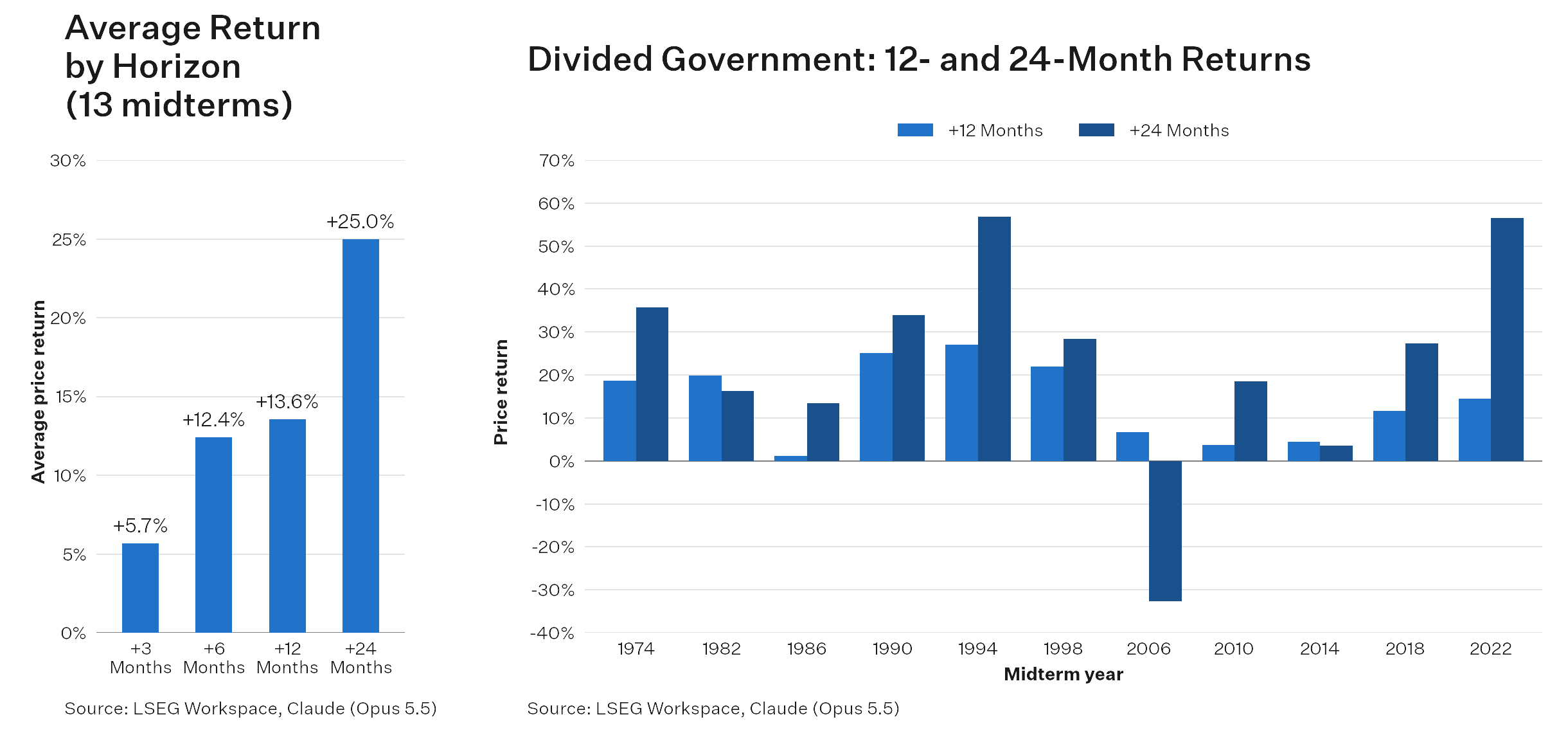
Historically, U.S. equity markets have performed well following midterm elections. Since 1966, the S&P 500 has posted positive returns in 100% of the 12-month periods following midterms, with an average gain of approximately 13%.4 Returns have been even stronger over the two years following midterms, averaging approximately 25% since 1974. This trend has generally held up regardless of which political party gains or loses power.5 With Democrats now controlling both chambers of Congress and President Trump retaining his veto power, the result is a divided government. Democrats are well short of the two-thirds majorities needed to override a veto, so any legislation will still need the President’s signature. Regardless of the exact configuration, markets have historically reacted positively to divided government. Since 1974, 11 midterms have resulted in a divided government, with the S&P 500 averaging a 14.1% return over the following 12 months and 23.5% over the following 24 months. Ten of those 11 two-year periods were positive, with the lone exception being 2006, a period that included the Global Financial Crisis. Markets tend to like gridlock because it can reduce policy uncertainty and lower the likelihood of significant legislative changes.6
For illustrative purposes only. Any trends depicted or described above may not continue. Past performance is not indicative of future results. One cannot invest directly in an index. An index is unmanaged and therefore is not subject to any of the transaction costs, fees or expenses associated with an actual investment. S&P 500 returns shown are price returns and exclude dividends.
Prescription drug prices:Both parties and the White House support lowering drug prices. Options under discussion include letting Medicare negotiate prices on more drugs, tying U.S. prices to what other countries pay, and tighter rules for pharmacy benefit managers.9 Much of this is already happening through executive action. More aggressive legislation would put further pressure on drug makers’ U.S. revenue, though it would likely face a veto, making bipartisan measures such as pharmacy benefit manager reform the more realistic path.
Data centers and AI’s power needs: Democratic gains at the state level could bring tighter rules on data centers. Democrats won governor’s races in Texas, Georgia, Michigan, Nevada, and Ohio. Except in Ohio, Democrats campaigned on stricter data center rules, including temporary pauses on new construction, fewer tax breaks, and tougher environmental, water, and electricity standards. Together, these states account for roughly 45% of planned U.S. data center capacity, with Texas alone at about 25%. However, data centers ranked low among voters’ priorities, so the issue may fade in the coming months, and any construction pauses may prove short-lived. Alongside the debate over whether and where data centers should be built, there’s a growing debate over who should pay for the new power plants and transmission lines they need.10 If policymakers decide data centers should bear more of that cost, utilities and grid operators could benefit from clearer rules. Some data center projects, however, could become less profitable, and local restrictions could slow AI infrastructure spending.11
Government spending: Congress has mostly funded the government through short-term extensions rather than full annual budgets. The current funding extension expires December 11. That deadline falls to the current Congress, but the new Democratic Congress takes office in January, giving it greater leverage over future funding negotiations and raising the potential for standoffs with the White House. Any agreement that raises non-defense spending would help government contractors, federal suppliers, and research and health care organizations that rely on federal grants.
Lido does not provide legal or tax advice or trustee services. S&P 500 is a stock market index tracking the stock performance of 500 leading companies listed on stock exchanges in the United States. For important disclosures and additional information, please visit lidoadvisors.com/disclosures.
Footnotes
1 J.P. Morgan, Equity Thematic Strategy: Midterm Elections, Scenario Analysis, Baskets (Oct. 1, 2026), pp. 1–4 and 17 (Figures 5, 6 and 50). 2 J.P. Morgan, Equity Thematic Strategy, pp. 1–2, 4 and 13 (Figures 6 and 32). 3 J.P. Morgan, Equity Thematic Strategy, p. 3; J.P. Morgan, US Corporate Credit: 2026 Midterm Election Implications (Oct. 16, 2026), pp. 1, 6, 8 (Figure 4) and 10 (Figures 9 and 10; analysis of investment-grade credit spreads). 4 J.P. Morgan, Equity Thematic Strategy, p. 13 (Figure 32, S&P 500 performance in the 12 months after each midterm since 1950). 5 J.P. Morgan, Equity Thematic Strategy, p. 3 (Figure 8); US Corporate Credit, p. 10 (Figures 9 and 10). 6 J.P. Morgan, Equity Thematic Strategy, pp. 2–3 (Figure 9); US Corporate Credit, p. 8 (Figure 4). 7 Goldman Sachs, What Matters Today: Tech Under Pressure, Top Midterm Ideas, Early Signs of a Tougher Labor Market for AI Displaced Workers (Oct. 30, 2026), “Top Midterm Ideas,” item 1. 8 Goldman Sachs, What Matters Today, item 1. 9 Goldman Sachs, What Matters Today, item 2; US Corporate Credit, p. 15. 10 US Corporate Credit, pp. 17 and 27–28; Goldman Sachs, What Matters Today, item 3. 11 US Corporate Credit, pp. 17 and 22. 12 J.P. Morgan, Equity Thematic Strategy, p. 3; US Corporate Credit, p. 6. 13 US Corporate Credit, pp. 6 and 10; J.P. Morgan, Equity Thematic Strategy, p. 4. 14 US Corporate Credit, p. 1 (discussing credit markets).
Marson, Pedro (2026). What Matters Today: Tech Under Pressure, Top Midterm Ideas, Early Signs of a Tougher Labor Market for AI displaced workers. Goldman Sachs
Lido Advisors, LLC is an SEC-registered investment adviser. Please note that SEC registration does not denote any particular competence or ability and no inference to the contrary should be made. For complete information on the services we provide and our fees, please review our Form ADV at adviserinfo.sec.gov, call (310) 278-8232, or mail us at 1875 Century Park East Suite 950, Los Angeles, CA 90067.
Past performance is not indicative of future performance. The information in this report is for informational purposes only and should not be relied upon as the basis of an investment or liquidation decision. Nothing in this report shall be construed to be a solicitation to buy or offer to sell any security, product or service to any non-U.S. investor, nor shall any such security, product or service be solicited, offered or sold in any jurisdiction where such activity would be contrary to the securities laws or other local laws and regulations or would subject Lido to any registration requirement within such jurisdiction.
Certain information contained in these materials has been obtained from published and non-published sources prepared by third parties, which, in certain cases, have not been updated through the date hereof. While such information is believed to be reliable, Lido has not independently verified such information nor does it assume any responsibility for the accuracy or completeness of such information. Except as otherwise indicated herein, the information, opinions and estimates provided in this presentation are based on matters and information as they exist as of the date these materials have been prepared and not as of any future date, and will not be updated or otherwise revised to reflect information that is subsequently discovered or available, or for changes in circumstances occurring after the date hereof. Lido’s opinions and estimates constitute Lido’s judgment and should be regarded as indicative, preliminary, and for illustrative purposes only.
Not all investments are suitable for all clients. It should not be assumed that any security listed or any recommendations made in the future will be profitable or without loss, including risk of loss of principal, or will equal any prior performance. All investments involve the risk of potential investment losses, including the potential risk of loss of principal, as well as the potential for investment gain. Further, the prior yield figures indicated herein represent performance for only a short time period and may not be indicative of the yield or volatility each security will generate over a long time period. The yield should also be viewed in the context of the broad market and general economic conditions prevailing during the periods covered by the performance information. Any references to future returns/risk are not promises of the actual return the client portfolio may achieve. Before investing, investors should seek financial advice regarding the appropriateness of investing in any securities of investment strategies discussed. Not all investments are suitable for all investors.
Certain information contained in this document constitutes “forward-looking statements,” which can be identified by the use of forward-looking terminology such as “may,” “will,” “should,” “seek,” “expect,” “anticipate,” “target,” “project,” “estimate,” “intend,” “continue,” “believe,” the negatives thereof, other variations thereon or comparable terminology. Due to various risks and uncertainties, actual events or results or the actual performance of the Fund may differ materially from those reflected or contemplated in such forward-looking statements.
Lido does not provide legal or tax advice. Lido’s affiliates, including, but not limited to, Lido Tax, LLC (“L-Tax”) and affiliated third-party legal professionals will, upon request, provide formal legal and tax services for Lido’s client under separate agreement. Prospects and clients are urged to seek the advice of their own independent counsel or tax professional should such services be required. Referrals to our affiliated providers available.
Lido specifically disclaims any and all liability arising from the information or illustrations presented in these materials and is not responsible for the consequences of any decisions or actions taken as a result.
IMPORTANT DISCLOSURES
Lido Advisors, LLC is an SEC-registered investment adviser. Please note that SEC registration does not denote any particular competence or ability and no inference to the contrary should be made. For complete information on the services we provide and our fees, please review our Form ADV at adviserinfo.sec.gov, call (310) 278-8232, or mail us at 1875 Century Park East Suite 950, Los Angeles, CA 90067.
Past performance is not indicative of future performance. The information in this report is for informational purposes only and should not be relied upon as the basis of an investment or liquidation decision. Nothing in this report shall be construed to be a solicitation to buy or offer to sell any security, product or service to any non-U.S. investor, nor shall any such security, product or service be solicited, offered or sold in any jurisdiction where such activity would be contrary to the securities laws or other local laws and regulations or would subject Lido to any registration requirement within such jurisdiction.
Certain information contained in these materials has been obtained from published and non-published sources prepared by third parties, which, in certain cases, have not been updated through the date hereof. While such information is believed to be reliable, Lido has not independently verified such information nor does it assume any responsibility for the accuracy or completeness of such information. Except as otherwise indicated herein, the information, opinions and estimates provided in this presentation are based on matters and information as they exist as of the date these materials have been prepared and not as of any future date, and will not be updated or otherwise revised to reflect information that is subsequently discovered or available, or for changes in circumstances occurring after the date hereof. Lido’s opinions and estimates constitute Lido’s judgment and should be regarded as indicative, preliminary, and for illustrative purposes only.
Not all investments are suitable for all clients. It should not be assumed that any security listed or any recommendations made in the future will be profitable or without loss, including risk of loss of principal, or will equal any prior performance. All investments involve the risk of potential investment losses, including the potential risk of loss of principal, as well as the potential for investment gain. Further, the prior yield figures indicated herein represent performance for only a short time period and may not be indicative of the yield or volatility each security will generate over a long time period. The yield should also be viewed in the context of the broad market and general economic conditions prevailing during the periods covered by the performance information. Any references to future returns/risk are not promises of the actual return the client portfolio may achieve. Before investing, investors should seek financial advice regarding the appropriateness of investing in any securities of investment strategies discussed. Not all investments are suitable for all investors.
Certain information contained in this document constitutes “forward-looking statements,” which can be identified by the use of forward-looking terminology such as “may,” “will,” “should,” “seek,” “expect,” “anticipate,” “target,” “project,” “estimate,” “intend,” “continue,” “believe,” the negatives thereof, other variations thereon or comparable terminology. Due to various risks and uncertainties, actual events or results or the actual performance of the Fund may differ materially from those reflected or contemplated in such forward-looking statements.
Lido does not provide legal or tax advice. Lido’s affiliates, including, but not limited to, Lido Tax, LLC (“L-Tax”) and affiliated third-party legal professionals will, upon request, provide formal legal and tax services for Lido’s client under separate agreement. Prospects and clients are urged to seek the advice of their own independent counsel or tax professional should such services be required. Referrals to our affiliated providers available.
Lido specifically disclaims any and all liability arising from the information or illustrations presented in these materials and is not responsible for the consequences of any decisions or actions taken as a result.