2025 Market Wrap Up
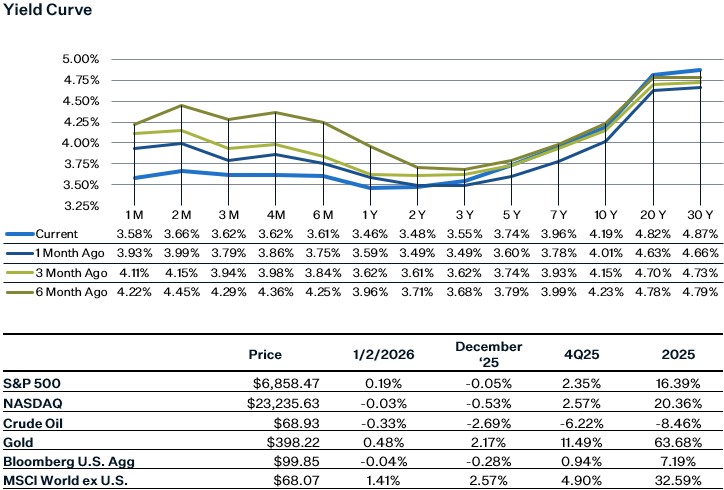
The S&P 500 ended 2025 with a third consecutive year of double-digit gains, driven primarily by enthusiasm around artificial intelligence and a better-than-feared macroeconomic backdrop. A “Goldilocks” environment with moderating inflation, resilient growth, and a stable labor market helped keep the economy on solid footing. Large caps outperformed small caps again, with the S&P 500 returning 16.39% versus Russell 2000’s 11.29%. Within large-cap, tech continued to drive most of the returns, as the equal weighted index (RSP) lagged the S&P 500 by roughly 7 percentage points. Unsurprisingly, AI chipmakers and AI infrastructure companies were among the best-performing areas. Industrials, being another AI-exposed theme, experienced strong returns as well. In contrast, Consumer Staples and Consumer Discretionary stocks underperformed in 2025, as economic uncertainty and tariff pressures weighed on lower- and middle-income consumers while tariffs affected consumer staples. AI scrutiny and questions around profitability became a main topic of discussion towards the end of the year however, with some AI stocks such as ORCL being subject to a sharp pullback. For 2026, forecasts remain constructive, though tempered by concerns around elevated valuations and the sustainability of AI capital spending.
We expect AI to continue to be a focus for investors in 2026. While tariffs and trade are likely to be more in the background than front and center this year, the implications of tariff policies and their impact on margins and consumer spending are still important. Additional sectoral tariffs are still a risk. In the more immediate term, the next government shutdown deadline is January 30th and there is still a lot of uncertainty around the outcome. This week is a busy economic-filled week, with the BLS jobs report for December being the notable standout. Additionally, President Trump is expected to name the Fed Chair successor this week, with Kevin Hassett remaining as the frontrunner.
Corporate Bankruptcies Rose to 15 Year High
Data from S&P Global Market Intelligence show that bankruptcies in 2025 surged to levels not seen since 2010, with 717 companies filing for bankruptcy from the start of the year through November. Commonly cited reasons for these filings were inflation, high interest rates, and tariffs, which disproportionately hurt smaller, import-dependent companies that were unable to easily shift their supply chains. Although tariffs alone may not have been a primary point of tension for many companies, the economic backdrop in which they were imposed significantly amplified their impact, effectively dealing a final blow to businesses already weakened by years of harsh economic conditions. Industrials were hit particularly hard in 2025, especially manufacturing, which hemorrhaged 70k jobs despite the US taking on a more protectionist stance. Consumer discretionary was the second-largest sector to file for bankruptcy, as notable chains such as Claire's, Forever 21, and Joann's went out of business as consumers prioritized essentials. These retailers were especially exposed to tariffs, as estimates from the Yale Budget Lab suggest tariffs will cost households an additional $1,800 per year, further inhibiting discretionary spending. What these bankruptcies continue to highlight is the ongoing K-shaped economy, where the disparity in performance between AI- and non-AI-related businesses continues to widen, leaving future economic growth in a narrowing set of companies.
US Economic 2026 Tailwinds
Optimism abounds for the first half of 2026, mainly due to lower Fed interest rates working their way through the economy and President Trump's tax legislation providing stimulus to both consumers and businesses. The boost from the fiscal stimulus could alone add 50 basis points to the first quarter GDP, with consumers enjoying larger tax refunds and smaller withholding from their checks in the new year. Corporations, on the other hand, benefit from making the 2017 tax cuts permanent, allowing full expensing of US-based R&D costs, and loosening limits on interest deductions. The fiscal stimulus amid less uncertainty in US trade policy, lower Fed interest rates, and ongoing build out in AI-related CAPEX should provide a strong start to the year; however, over the course of the year, the stimulus is expected to dissipate, and policy is expected to become restrictive as spending from state and local governments slows down.
Sources:
https://www.washingtonpost.com/business/2025/12/27/corporate-bankruptcies-economy/
https://www.brookings.edu/articles/hutchins-center-fiscal-impact-measure/
https://www.reuters.com/business/finance/tax-changes-loom-large-us-economy-2026-2025-12-29/