Market Update
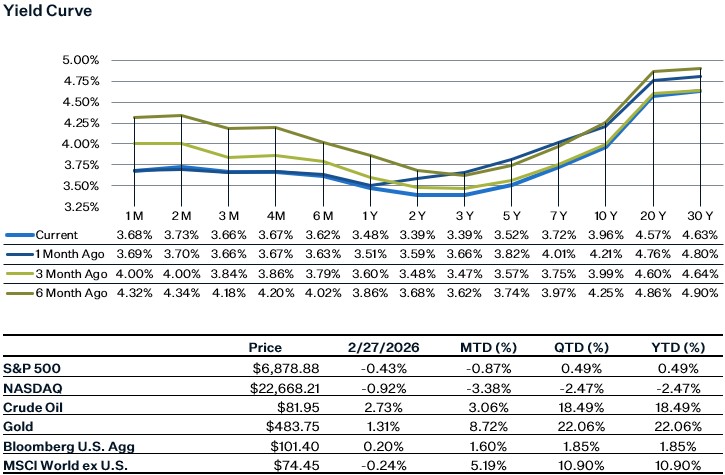
February was a choppy month for the S&P 500, driven by renewed AI disruption concerns impacting industries such as software and banks, while the equal-weight counterpart (RSP) rose 3.47%. Much of the AI fear stemmed from a hypothetical scenario published by Citrini Research portraying a future in which widespread AI deployment leads to job losses, reduced consumption, and financial stress, although even the authors emphasized this was not their base case. Meanwhile, the Fed minutes reflected a noticeable shift toward a more hawkish stance. Even Governor Waller, who has been one of the more dovish voices on the board, signaled that if February labor data confirms January’s strong job growth and low unemployment, it may be appropriate to keep rates unchanged, marking a shift in focus away from growth concerns and back toward inflation risks. Furthermore, the Producer Price Index increased 0.5% for the month, the strongest gain since September, driven largely by services. Despite declines in gasoline and food prices, underlying goods inflation posted one of its strongest increases since early 2022, with tariffs likely contributing to rising costs in areas such as equipment, metals, and machinery. As a result of the shift in rate expectations, combined with AI-related uncertainty and elevated valuations, the S&P 500 has underperformed, while international markets have generally held up better, supported by more attractive valuations and improving growth expectations in parts of Europe and select Emerging Markets.
Iran and Middle East Escalation
The events in Iran and the Middle East over the weekend have sparked further increases in geopolitical tensions and instability in the region, however the impact on the global economy and global markets is far from certain. The main risk to the economy and markets is that the supply of oil gets severly disrupted via reduced flows through the Strait of Hormuz. Around one-fifth of the world’s crude oil and LNG supply passes through the Strait of Hormuz daily, along with other petroleum products and shipments. The Strait of Hormuz has never been officially closed, but shipping has been disrupted in the past. As of now, a likely scenario is that there is a partial disruption in traffic which limits the amount of oil that passes through the Strait and thus reduces the supply of oil. We are already seeing traffic through the Strait decline and being redirected through alternative routes, with some shipping companies announcing they have suspended vessel crossings. Given that Iran exports its own oil through the Strait and their economy heavily relies on those exports, a full closure is unlikely at the moment. The impact of this disruption on the price of oil of course depends on the duration and the extent to how much it limits supply. The initial reaction within oil markets is unsurprisingly an increase in price, with brent crude oil reaching a 52-week high at one point on Monday. However, it would likely take a severe and sustained oil disruption to substantially impact oil and global equity markets. The situation remains very dynamic and highly uncertain, and we will be be closely watching how things unfold and by what means they could affect markets in the near-term.
January PPI
January headline PPI increased 0.5% month-over-month (2.8% year-over-year), above expectations and higher than December 0.4% monthly increase. Core PPI rose 0.8% month-over-month, well above expectations of 0.3% and keeping the year-over-year rate high at 3.4%. The sharp increase was driven by higher services prices, which rose 0.8%. Trade services, along with transportation and warehousing services costs rose sharply. Trade services measure the margins of wholesalers and retailers - these margins reflect the difference between a trader's purchasing cost of a good and the price that the trader charges the final buyer. This suggests elevated pass-through of costs to customers. If you exclude those categories, core services PPI was essentially flat for the month.
We saw strength in core goods prices as well – with core goods increasing 0.7% month-over-month. The increase in core goods prices looks to be tied to AI demand and data center demand, with communication equipment and electronic components seeing significant increases in January. We’ll see how these price increases affect PCE when we get the January numbers on March 13th, but this could mean PCE numbers for January come in higher than December. If we see another firm PCE number, then that most likely strengthens the case that the Fed remains on hold for longer given that many Fed members have recently stressed the latest elevated inflation readings.
A Tale of Two Cities – “SaaS-pocalypse” Concerns Continue to Grip Markets
Concerns about the “SaaS-pocalypse” persisted last week, as major SaaS leaders such as SNOW, CRM, and WDAY reported solid results that beat analyst expectations, yet shares still fell or remained flat amid investor anxieties of any potential AI disruption. Thus far, the software sector’s financials do not appear to be massively affected by the new technology, as nearly 87% of the reporting software companies have exceeded EPS expectations, compared with 75% for the broader S&P 500, but there are signs that show monetization around the seat-based revenue model is cooling. This can be seen in WDAY’s slightly lowered subscription growth guidance for FY27 and in CRM's sluggish growth in its marketing and commerce segments; however, for both companies, segments with exposure to AI agents are showing explosive growth, though the scale of these segments is small as of now. This dynamic is creating a juxtaposition that is unsettling to markets, as it's not yet clear what the future revenue model for these companies will be as they transition away from the seat-based model, and there is widespread uncertainty about how customers will adopt these tools. Until markets become more certain about the answers to these questions, earnings projections for these software companies will carry a higher degree of uncertainty than previously was the case, and the sector is likely to remain under sustained pressure. Software companies that will continue to thrive beyond this transition period are likely those that can vertically integrate across tech stack layers, have AI agents that hallucinate far less than competitors, and are platform providers.
Sources:
https://markets.jpmorgan.com/jpmm/research.article_page?action=open&doc=GPS-5220806-0
https://www.bls.gov/news.release/archives/ppi_02272026.htm
https://tradingeconomics.com/commodity/brent-crude-oil