Market Update
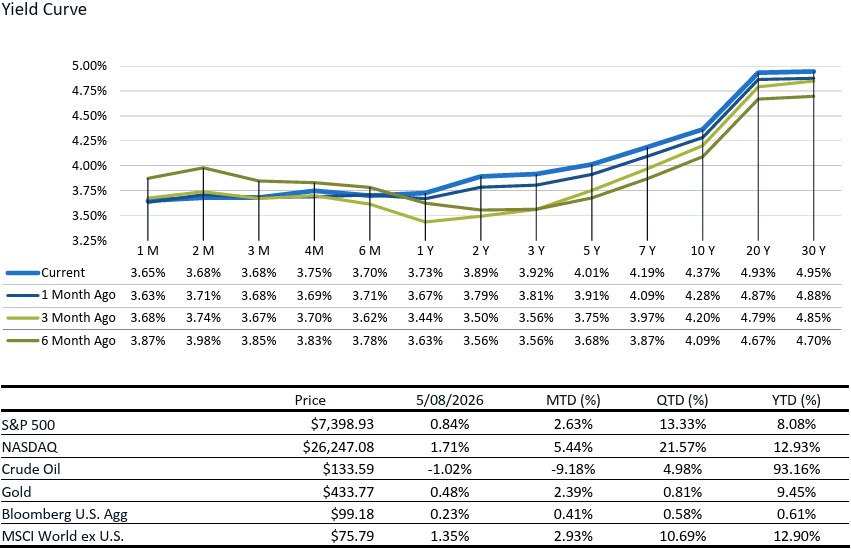
U.S. equities ended the week notably higher again - as major tailwinds such as AI optimism, a resilient macro backdrop, and a particularly strong earnings season remained in place. With 89% of S&P 500 companies having reported, this is shaping up to be one of the strongest earnings seasons in years. Approximately 84% of companies have beaten EPS estimates, well above both the 5- and 10-year averages (78% and 76% respectively), while the magnitude of those beats is running at 18.2% above expectations which is also above the 5 and 10 year average (7.3% and 7.1% respectively). While Alphabet, Amazon, and Meta have been the largest contributors to the increase in earnings growth since quarter-end, earnings breadth has also improved as seven of eleven S&P 500 sectors are currently delivering double-digit earnings growth.
Main economic data point for the week was the April jobs report. The April numbers continued to suggest the labor market is in decent shape, and concerns around a meaningful labor market slowdown have eased considerably compared to the beginning of the year. However a surge in labor market demand seems unlikely given the economic uncertainty caused by the US-Israel/Iran War. While recent Manufacturing and Services indicators have remained constructive, suggesting the economy continues to absorb the shocks stemming from the Iran conflict, we are beginning to see mounting pressure on prices and a more cautious tone in business sentiment, reducing the margin for error going forward. As earnings season begins to wind down, we expect market participants to shift their focus back toward economic data. This week we have the CPI report for April coming out on Tuesday where we will be looking for any spillover effects from higher energy costs, as well as retail sales data on Thursday.
April Jobs Report
The April jobs headline number came in significantly above estimates of 63k, with nonfarm employment up 115k for the month of April. This marks the first back-to-back positive jobs number we’ve had in exactly a year. Job gains were the largest in in the healthcare and social services (+54k), transportation and warehousing (+30k), and retail trade (+22k) industries. This brings the three-month average job growth number to 48k, which fits the narrative of a slow but stable economy. Government employment continues to fall, with government sector jobs declining by 8k for April.
Other details of the report showed some softness – in particular the household survey measure of employment declined by 226k for the month and that figure has declined for four straight months. The unemployment remained at 4.3%, but when you look at the unrounded figure it actually almost increased a full percentage point – going from 4.256% in March to 4.337% in April. This is happening while the labor force participation has been slowly ticking down over the past year and is now at 61.8%, a full percentage point lower than in November 2023. In addition, the number of recently unemployed increased significantly, with the number of unemployed less than 5 weeks increasing by 16% from March to April. Average hourly earnings increased 0.2% last month, keeping the year-over-year number at a mild rate of 3.6%. The labor market seems to be in decent shape but the ultimate impact from the Iran war remains an unknown. The large energy cost shock from the war could lower labor demand by making companies reluctant to hire until there is more clarity around the economy, and AI could turn into a more meaningful headwind to employment later on in the year.
Earnings Update - Tech/Semi Focus
Earnings season continued to come in strong last week, with roughly 440 of S&P 500 companies reporting results so far, and 84% exceeding analyst expectations, well above the long-term average earnings beat. Tech has been a central focus of the market, as Capex spending from the large hyperscalers continues to be revised higher, driving upward momentum in the semiconductor space. To put the spending into perspective, AI capex spending by the five largest hyperscalers alone is expected to reach roughly 2.5% of GDP in 2026 and 3.3% in 2027, compared to defense spending, which is projected to remain around 2.7% of GDP in both 2026 and 2027. The result of all of this has been a massive tailwind for semiconductor firms, as Q1 2026 revenue for the space has grown about 26% quarter-over-quarter and 79% year-over-year, the highest Q1 growth rates since 1991. From last week's earnings reports, AMD stood out as a clear beneficiary of the spending, beating analyst estimates on both the topline by 3.6% and the bottom line by 7%. Notably, AMD also announced that data center revenue growth came in strong at 57% year-over-year and doubled its projected CPU total addressable market from 60 billion to 120 billion by 2030. Overall, the AI trade remains intact, and the earnings picture for the S&P 500 remains positive, with current 2026 growth expectations being at roughly 22%, and for 2027 at 14%; however, NVIDIA’s earnings on May 20th will need to be closely watched as those results will likely set the tone for the AI narrative going forward.
April Economic Activity
We've been closely watching the ISM and PMI reports for real-time reads on how the Iran conflict is flowing through the economy. In April, both indicators remained in expansion territory, with Manufacturing at 52.7 and Services at 53.6, as readings above 50 signal economic expansion. On the surface, the data appears constructive; however, beneath the headline numbers, pressures are beginning to build. Input costs continue to accelerate, employment trends are weakening, and business sentiment has become increasingly cautious. At the same time, employment conditions continue to soften. Manufacturing employment has now contracted for 31 consecutive months, while services employment declined for a second straight month, reflecting companies managing labor through attrition rather than expanding headcount. With margin pressure intensifying from higher input costs, firms appear reluctant to add capacity in an increasingly uncertain environment. Respondents across both sectors also highlighted that the full impact of rising fuel costs has not yet been fully realized, while supply chain rerouting around the Strait of Hormuz continues to increase both costs and lead times with no clear resolution timeline. Additionally, the front-loading of orders that temporarily boosted March activity has faded, leaving underlying demand softer than the headline data initially suggested. For now, the economy has been able to absorb the shock however the margin of error is narrowing.
Sources:
https://markets.jpmorgan.com/jpmm/research.article_page?action=open&doc=GPS-5296465-0 https://markets.jpmorgan.com/jpmm/research.article_page?action=open&doc=GPS-5289156-0 https://markets.jpmorgan.com/jpmm/research.article_page?action=open&doc=GPS-5288437-0 https://www.wsj.com/tech/ai/ai-is-distorting-practically-everything-about-the-economy-4ca6fcff? https://www.reuters.com/business/us-stock-futures-rise-chips-rebound-ahead-jobs-data-2026-05-08/ https://insight.factset.com/sp-500-earnings-season-update-may-8-2026
https://www.ismworld.org/supply-management-news-and-reports/reports/ism-pmi-reports/pmi/april/