Market Update
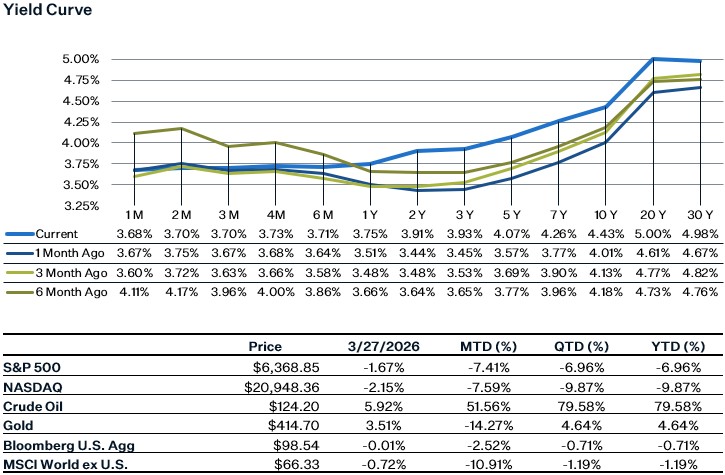
Investor skepticism around near-term de-escalation has weighed on markets, with the S&P 500 down 3.13% and the Nasdaq 100 falling 4.69% last week. The outperforming sectors for the week were Energy, Materials, Utilities, and Consumer Staples, as markets continued their rotation to those that stand to benefit from the conflict and more defensive sectors. The key risk in the Iran conflict is duration - oil remains volatile in the $100–110 range, and while markets still expect a decline toward $85, prolonged disruptions would increase downside risks, particularly outside the U.S.. The VIX reached 31 on Friday, the highest level since last April when the Liberation Day tariffs were announced. Additionally, US treasury yields rose dramatically, with the 10-year yield climbing to 4.43% on the back of inflation fears. The state of the war in the Middle East remains very unclear, and the US’s 10-day postponement of strikes on Iranian energy infrastructure only prolongs the uncertainty. At the same time, more innovation around AI has sent the tech stocks lower, this time around memory chips as Alphabet publicized research on a new algorithm that could allow more efficient use of the storage needed for artificial intelligence development. Together, geopolitical uncertainty and technology reconfiguration pushed the Nasdaq 100 into correction territory on Friday.
Looking into this week, it’s a busy week of economic data – with retail sales and the March jobs report being two of the main ones to watch as they will be key data points on the consumer and the labor market. Consensus is expecting the unemployment rate to remain at 4.4% and for headline payrolls numbers to come in at 59k. It’s important to note that any potential impact the conflict has on the labor market won’t show up until later reports, as oil price shocks typically affect labor market data with a lag.
March Flash PMI Show a Difficult Backdrop
The flash PMIs for the US in March showed that the economic environment may be heading toward an unfavorable path of lower growth and elevated inflation. Although there was an uptick in manufacturing growth, services growth continues to be weak via a decline in new orders. Input costs increased to a 10-month high, with businesses noting they in turn raised prices to customers by the largest increase in over 3 and a half years. Employment fell for the first time, albeit modestly, registering the first decline in employment since February 2025. S&P noted that given this month’s PMI data, their estimation of GDP growth for Q1 is a modest 1.3%. We’re only starting to see the impact of the conflict unfold in the data, but so far it’s looking to be a difficult backdrop for the economy.
The “K” shaped economy and Iran
The surge in energy prices is creating a meaningful but uncertain headwind to growth, with the key question being how much it offsets the $200bn in expected tax cuts. According to JP Morgan, gasoline around $4/gal implies roughly a $100bn hit to consumer purchasing power, which does not fully offset tax relief, but if prices rise toward $5/gal, the drag could materially erode or even exceed the benefit. Gasoline demand is relatively inelastic in the short term, meaning higher prices translate almost directly into higher consumer spending on energy and less discretionary spending elsewhere. Each $0.10 increase in gas adds $12bn in annual costs, reinforcing the idea that energy acts like a direct tax on households. Importantly, the distributional impact differs, tax cuts are skewed toward higher-income households, while higher gasoline costs are felt more evenly across income groups, increasing the risk of a broader consumption slowdown. Beyond gasoline, rising energy and input costs, such as fertilizers, industrial materials, which could gradually push up goods prices, while also compressing corporate margins—potentially weighing on wages, employment, and equity markets. While tax cuts should still provide a net positive boost, elevated energy prices are acting as a counterforce. If oil and gasoline prices remain high or rise further, they pose a clear downside risk to consumer spending and overall growth in 2026.
Fed Proposes Loosening Bank Capital Rules
Recently, US regulators, including the Federal Reserve, voted 6–1 to propose a rollback in bank capital requirements and broader financial regulations. The implications of such a rollback in regulation would mark an attitudinal shift from safety to growth, and for banks, it would unlock massive amounts of locked-up capital, with the big six now nearly having $200 billion in excess reserves to lend, buyback stock, or pursue other productive avenues. The expected increase in credit should support the US economy, with areas like small-business lending and mortgages getting a boost as banks lend more and pass along lower funding costs through lower interest rates. A more important implication is for private credit, as the new proposal modestly lowers the capital requirements for certain assets previously mentioned, compared to private credit, which often has no capital requirements for the assets it owns. The result would be more competition in the private credit space, as regulatory walls that once barred banks from lending in this space would be reduced. Since banks can raise capital more cheaply than private credit providers, this could squeeze the profitability of these established firms. Going forward, banks are likely to continue making the case to regulators for further relaxation of liquidity requirements, particularly regarding the holding of treasuries, with industry leaders often expressing frustration that they have high liquidity but are barred from deploying that capital. If these rollbacks in banking regulation are cemented into law, it would change the competitive landscape between banks and private credit providers, and may result in moderately easier access to credit for borrowers.
Sources:
https://markets.jpmorgan.com/jpmm/research.article_page?action=open&doc=GPS-5247821-0
https://markets.jpmorgan.com/jpmm/research.article_page?action=open&doc=GPS-5240947-0
https://www.pmi.spglobal.com/Public/Home/PressRelease/adc91b5cf42442cbb220d5b66b64ec7d