Market Update
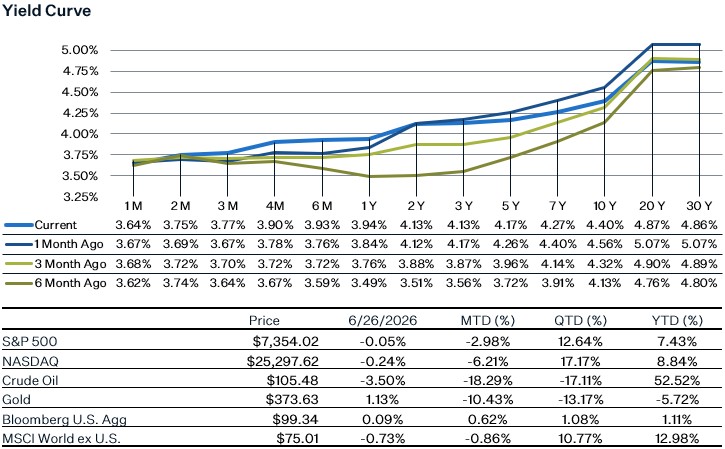
Last week the AI trade showed some cracks as there was some rotation underneath. The Nasdaq fell 4.6% and the S&P 500 declined nearly 2%, while the Equal Weight S&P 500 (RSP) finished the week higher, suggesting investors were taking profits in AI-related names and rotating into other areas of the market. The concerns came from two fronts. First, higher technology costs began to show up in consumer products. Apple fell roughly 6% after announcing significant price increases across its product lineup, while Microsoft also raised Xbox prices, with both companies pointing to higher chip and component costs tied to AI. Second, OpenAI is reportedly considering delaying its IPO until next year due to the weak post-IPO performance of SpaceX and the recent volatility across AI-related stocks, adding to concerns about how long the current pace of AI infrastructure spending can be sustained. That said, this wasn't a broad risk-off move. Lower oil prices and declining interest rates supported a rotation into more cyclical sectors, with machinery, homebuilders, travel, and banks outperforming during the week. While the ceasefire in the Middle East remains in place, tensions are still elevated. On Friday, President Trump stated that Iran violated the truce with a drone strike on a cargo ship in the Strait of Hormuz, a reminder that oil prices and rate expectations remain highly sensitive to geopolitical developments. Looking ahead, the focus shifts to Thursday's nonfarm payrolls report, which should provide another important read on the strength of the labor market and the Fed's path forward.
Monday Quick Hits
- The AI boom is undergoing a sharp shift in perception rather than a cycle end; markets are aggressively punishing heavy capex spenders and margin-crimped hardware giants while rewarding supply-bottleneck beneficiaries like memory producers.
- The S&P 500 Equal Weight Index is outperforming its market-cap weighted counterpart year-to-date because of the rotation away from the Mag 7. The cash was redistributed into the other 493 names, boosting value, defensives (like healthcare).
- Oil relief has curtailed inflation upside, and the primary risk to the US markets now is an economic slowdown.
May Personal Consumption Expenditure (PCE)
The month-over-month (MoM) figure for Nominal PCE in May beat expectations, coming in at a gain of 0.70% versus expectations of 0.50%, a sign that the US consumer continues to remain resilient amid both rising inflation and geopolitical uncertainty. The inflation-adjusted measure, Real PCE, further confirmed this by coming in at a gain of 0.30%, showing that the nominal gains weren’t just a reflection of higher prices, but of genuine consumer demand, with the main drivers being personal incomes increasing 0.70% and a one-time USDA relief payment to farmers, which boosted incomes. A potential concern was that the personal savings rate remained low at 3%, with April’s savings rate at 2.60%, the lowest since June 2022. Meanwhile, Core PCE increased 3.4% year-over-year, showing that the Fed’s preferred price indicator remains well above its 2% target. Although the report is backward-looking and therefore doesn’t reflect the drop in oil prices in June, the effects of earlier energy price increases are still working their way through the supply chain, as businesses further downstream have yet to fully adjust their pricing. The implications are that inflation may remain stubbornly elevated even though oil prices have fallen, leaving the Fed with no choice but to remain hawkish on its rhetoric and scrap the idea of any rate cuts it previously thought were appropriate. The AI buildout is also starting to create inflationary pressure on consumer electronics, as seen by computer software and accessories prices increasing 5% in April. Prime examples of inflation in electronics include both Microsoft raising prices on its gaming consoles and Apple similarly increasing prices on its devices due to elevated memory costs. Overall, the picture remains supportive for consumers as they continue to spend due to solid wage gains and relatively tight labor markets, but with a lower savings rate and inflationary pressures, there are reasons for concern about whether consumer strength will remain as sturdy or begin to soften.
Sources:
https://www.bea.gov/news/2026/personal-income-and-outlays-may-2026