Market Update
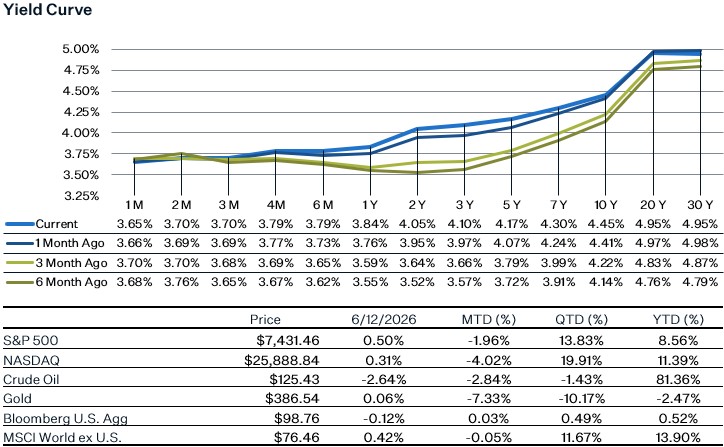
U.S. equities locked in modest gains last week though it came it with volatility throughout. Mid-week we saw a pullback in semis and semi-related stocks, however they rebounded due to some positive AI headlines around capex. The highly anticipated IPO of SpaceX ended its first day up 19%, bringing the market cap up to roughly $2.1 trillion. SpaceX will also join Nasdaq-100 in July, thanks to updated rules giving investors another avenue to gain exposure to the stock. Inflation was the main economic story for the week, with May’s CPI report coming largely in line with expectations – core inflation came in a little weaker than expected but headline inflation saw another strong increase (4.2% year-over-year) driven by energy prices. Stocks ended the week up on Friday as investors reacted to positive updates regarding the US and Iran. Additional positive developments came over the weekend when the US and Iran announced a temporary peace deal that is supposed to officially signed and go into effect on Friday. The deal stipulates a 60-day ceasefire and that the Strait of Hormuz will be open for vessel traffic. This week we have the FOMC meeting on Wednesday where this will be Chair Warsh’s first meeting since becoming Chair. Investors will likely be paying close attention to the post-meeting statement to see if there are any changes in wording around policy easing (which several members wanted to take out last meeting) and will be analyzing the dot plot for changes in their Fed funds rate forecasts.
Inflation – May CPI
Inflation picked up in May, reaching its fastest annual pace in more than three years, but much of the increase was driven by higher energy prices tied to the Iran conflict rather than broad-based inflation. CPI rose 0.5% for the month and 4.2% year over year, with energy accounting for more than 60% of the increase and gasoline prices jumping 7.0%. While that pushed headline inflation higher, recent declines in gas prices suggest some relief may already be underway, though higher transportation and fertilizer costs remain worth monitoring. Excluding energy and food, inflation was softer than expected. Core CPI increased just 0.2% versus expectations of 0.3%, bringing the annual rate to 2.9%. Core goods prices declined for the first time in a year, suggesting tariff-related pressures are easing. Softer motor vehicle insurance prices and stable technology goods also helped keep core inflation contained. For the Fed, this report is somewhat mixed. The rise in energy prices is largely a supply shock, something policymakers typically look through, making a rate hike less likely. However, with headline inflation still above target and risks from tariffs, supply chains, and AI-related spending lingering, the focus at next week's meeting will likely be on how the Fed communicates its outlook while keeping the door open for future rate cuts.
May PPI
The May headline producer price index came in hot at 6.50% Year-over-Year (YoY), above the street expectation of 6.40%, and marking the highest print since November 2022. Unsurprisingly, goods were the largest contributor, rising 2.80% month over month (MoM), driven by gasoline, which rose 23.40% MoM, while services remained relatively cool, increasing only 0.30% MoM. Core PPI similarly remained elevated, coming in at 5.1% YoY(ex-Food, Energy & Trade Services) and 0.40% MoM (ex-Food & Energy), above the consensus of 0.30% (ex-Food & Energy), and remains at the highest level since October 2022. One of the interesting factors that emerges from the BLS report is a view into the inflation pipeline building, as right now a bulk of the price increases appear to be concentrated in the unprocessed goods portion, which includes commodities such as crude oil, cattle, and corn, and was higher by 22.2% than 12 months ago. Processed goods, meanwhile, which are made up of more refined items such as plastic resin and industrial chemicals, increased by 13.3% YoY, and we see the pattern emerge of lower inflation the further down the supply chain we move. What may occur, even if the conflict begins to wind down soon, is that unprocessed goods producers will raise prices on the processed goods supplier, potentially triggering a ripple effect on inflation as it moves through the supply chain. The takeaway from the report is that lowering inflation is not as simple as ending the conflict, since adjustments throughout the supply chain are likely to continue, thereby prolonging the effects of higher prices even after the conflict has ended.
Sources:
https://www.bls.gov/news.release/ppi.nr0.htm